

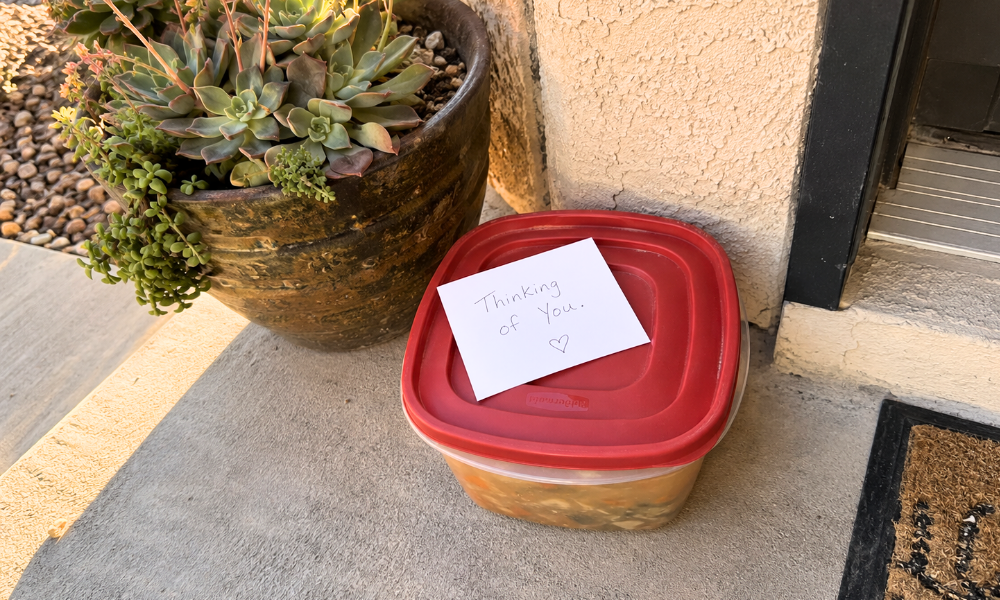
“Let me know if there is anything I can do.” You’ve said it. Probably more than once. Your friend’s spouse had surgery, or their mom’s dementia took a turn, and you texted: let me know if you need anything. You meant every word of it.
Here’s the problem: that phrase doesn’t give them anything they can actually act on.
If you know someone who’s caring for a spouse, a parent, or an aging loved one with a serious illness, you already sense they’re carrying a lot. What most people don’t realize is how much of that weight comes from a kind of loneliness — the specific loneliness of running on empty while everyone around you offers help in a way that’s too vague to accept.
The problem isn’t that people don’t care. It’s that vague care is hard for the caregiver to use.
Caregivers are already stretched thin, managing appointments, medications, and someone else’s needs on top of their own life. When you say “let me know if you need anything,” you’re handing them one more task: figuring out what they need, then working up the nerve to ask for it. Most won’t. Not because they don’t need help, but because naming a need out loud feels like a burden they don’t want to pass on to you.
The same goes for “I’m here if you need me” and “I wish there was something I could do.” All three come from a good place. But they tend to land as a polite formality instead of a real offer, and they’re easy for a stressed, exhausted person to forget by dinnertime.
The fix isn’t a bigger gesture. It’s a more specific one.
Small, specific, and repeated beats big, vague, and once
You don’t need a grand plan to support a caregiver well. You need a habit of showing up in small, concrete ways, over and over, for as long as they need it.
That can look like:
- A text with a real offer, not an open door. “I’m at the grocery store, what can I grab you?” is something a caregiver can say yes to. “Let me know if you need anything” isn’t.
- A meal without the coordination. Drop off dinner they can freeze, or just share what you already made: “I’ve got extra soup, want some?”
- An offer to sit with their loved one. Even 30 minutes lets them take a walk, run an errand alone, or just sit in the other room in silence.
- A question that actually opens a door. “How are you?” usually gets a reflexive “fine.””What’s your biggest challenge right now?” gives them a space to talk.
- A small gift that says you thought of them specifically. A candle, a favorite snack, a puzzle, a book. It’s not about the price tag, it’s about the reminder that someone sees what they’re carrying.
None of this requires a lot of time. It requires attention, and a willingness to keep showing up even after the initial crisis has faded and everyone else has moved on.
Watch for the signs they won’t say out loud:
Caregiving takes a real physical and emotional toll, and caregivers are often the last to notice it in themselves. Fatigue that doesn’t lift. Irritability that’s out of character. Pulling away from things they used to enjoy. These are worth paying attention to, not because you need to fix them, but because being the person who notices can be exactly what someone needs.
Sometimes just being present is the whole point. You don’t have to solve their problem. You just have to not look away from it.
Want a real plan for how to help?
We put together a free guide called Caring for the Caregiver that walks through this in a lot more depth: what to say, what to avoid saying, ways to help through food and small gestures, how to spot caregiver stress before it turns into something serious, and a printable action plan you can actually follow.
If someone in your life is quietly carrying this weight, this short ebook is FREE and worth carving out some time to read.
